Fairphone Gen. 6 Ownership Review: Repairability Is Most Valuable When Parts Can Reach You
The Fairphone Gen. 6 is attractive for a specific reason: it gives an owner a clearer route to replace several worn or damaged parts while a long software-support roadmap remains in place. That is a different proposition from buying the fastest phone for a particular price. The benefit is greatest for someone who plans to maintain a phone and can actually obtain the relevant parts and service.
This review evaluates Fairphone’s published repair information and support roadmap. It does not claim hands-on durability, battery or camera testing. The original Gen. 6 is the subject here; Fairphone’s later Gen. 6+ has its own launch software and upgrade count, so those details should not be mixed in a seller listing.
A long roadmap needs the correct model name
Fairphone’s roadmap for the original Gen. 6 specifies at least seven Android version upgrades and at least eight years of security updates, with support through June 2033. Its published schedule also changes the security-update cadence later in the period. That is more useful information than a vague claim of long support, because an owner can compare it with a planned replacement date.
Do not count eight fresh years from an imported purchase made well after launch. Also distinguish ordinary Android from an alternative operating-system edition. The same physical phone can be sold with a different software arrangement, and application compatibility, support contact and update delivery need checking for that exact edition. Those questions matter most for banking, work and authentication apps.
Replaceable parts are an exit from some faults
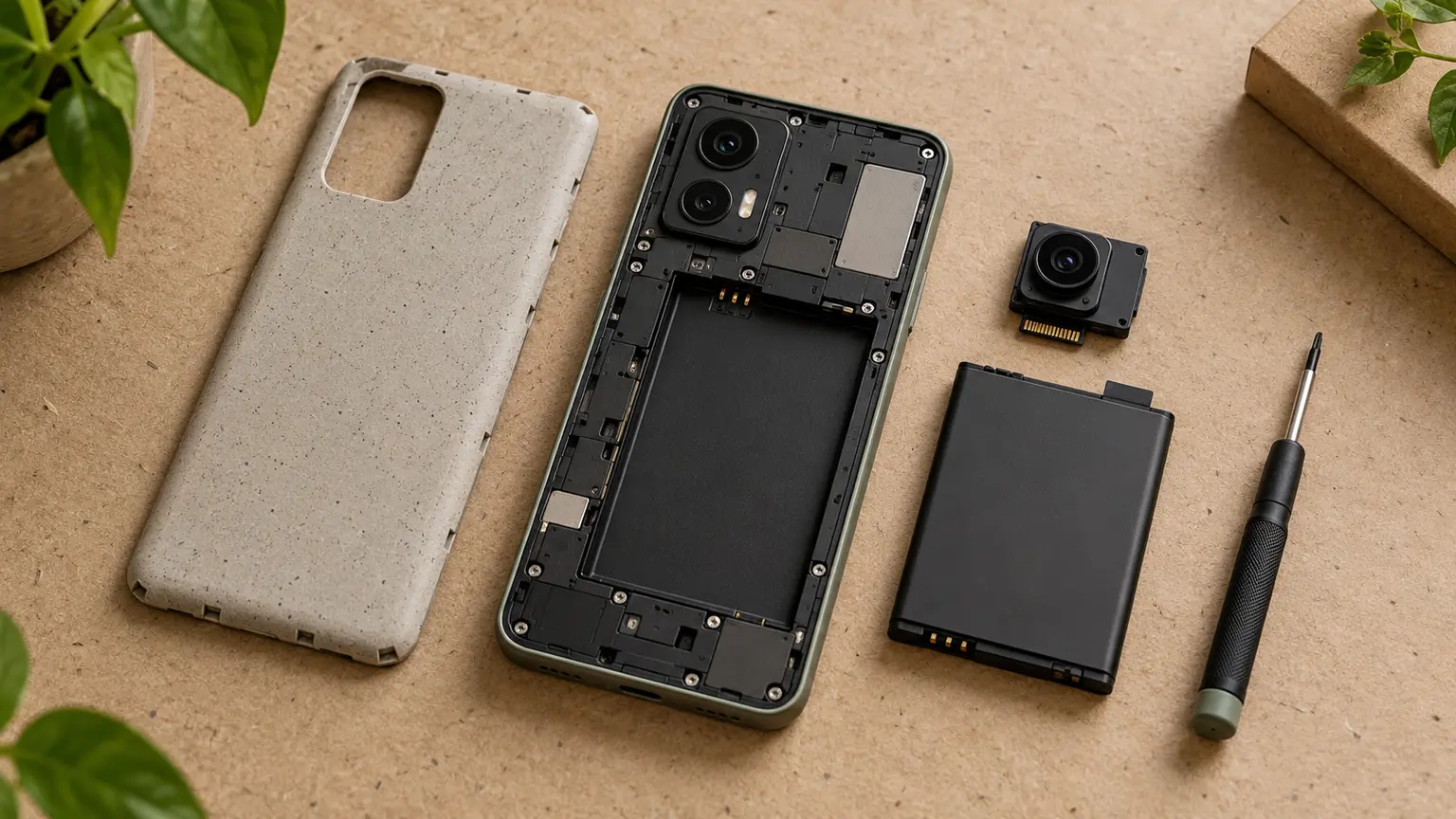
Fairphone publishes guides for replacing the battery, display, cameras and earpiece, and the loudspeaker and USB-C port assembly. That means a worn battery or damaged connector need not automatically become a whole-phone replacement. It does not mean every fault is cheap, every repair is suitable for a beginner or every module can be purchased individually.
The current repair information explicitly says the Core Module is not sold as a standalone spare part. A suspected fault in that central assembly therefore requires a different service route from a battery replacement. This boundary should appear in the buying decision. Modularity is useful because it expands some repair options, not because it abolishes serious failures.
Make a parts-delivery plan before importing
Ask whether the parts shop ships to your address, who pays import charges and how long a battery or display normally takes to arrive. If a local repairer will perform the work, ask whether they are comfortable with the exact model and whether their warranty covers labour as well as the installed part. A catalogue of parts overseas is less helpful when a broken phone leaves you without communication for weeks.
The cost comparison should include a fallback device if downtime matters. For an office worker with a spare phone, waiting may be inconvenient but manageable. For someone whose business calls and authentication all depend on one phone, the same repair delay can be much more expensive. These are different ownership situations even when the hardware is identical.
| Possible fault | Ownership advantage to investigate | Limit to keep in the budget |
|---|---|---|
| Worn battery | Published replacement route | Part delivery and labour |
| Broken display | A documented module repair | Price, availability and other drop damage |
| Charging-port fault | A replaceable assembly may help | Diagnosis before ordering a part |
| Suspected mainboard fault | Specialist service route | Core Module is not an individual retail spare |
Repair economics without a promise of eight years
Suppose a repairable phone costs 140 currency units more than another suitable model. If an eventual repair saves you from buying a 400-unit replacement, the premium could be recovered. If the required parts cannot reach you, the theoretical saving may never materialise. The figures are hypothetical and deliberately exclude resale, delivery, taxes and downtime until you add your own values.
Do the comparison in both directions. A phone bought cheaply and used reliably for years may be excellent value even with a less modular design. A repairable phone may justify a premium for easier maintenance and reduced replacement risk. Neither outcome can be determined from a repairability label alone; actual quotes and your willingness to maintain the device decide it.
Before attempting any repair
Use the procedure for the exact generation and check warranty coverage before ordering a part. Back up data and diagnose the fault first. An intermittent cable can imitate a port failure, while software behaviour can imitate a battery problem. Replacing a part without that check can add cost without solving the issue.
A modular design does not make a damaged lithium-ion battery harmless. If there is swelling, severe heat, liquid damage or a distorted enclosure, stop treating the job as a routine upgrade and get qualified assessment. This review is a purchase assessment, not an instruction to open a damaged phone.
Who gets the most from the Gen. 6
It fits an owner who values keeping a device, accepts the exact software edition and has a credible parts-and-service route. It is less persuasive for someone who replaces phones frequently or cannot obtain local support, because much of the ownership advantage would go unused. There is no need to pretend those buyers have the same priorities.
Before buying, price one battery repair and one display repair delivered to you. If those repairs are practical and the support deadline covers your planned ownership, the Fairphone Gen. 6 has a coherent long-term case. If the plan depends on uncertain overseas help, resolve that uncertainty before paying the repairability premium.