A Repairability Score Is Not a Repair Quote: Why the Number Can Mislead Buyers

A repairability score can tell you that one device is designed to be easier to open, document, or supply with parts than another. It cannot tell you what a broken screen will cost next Tuesday in your city. A score is a model-level indicator; a repair quote is a fault-level transaction.
Confusing the two leads to bad purchases. A highly rated phone can still have an expensive display, no nearby technician, and a long parts delay. A lower-rated laptop may have a cheap, familiar battery replacement through a local shop. Use the score to ask better questions, then obtain prices for the repairs you are actually likely to need.
What a score is trying to summarize
Formal repairability systems combine several factors into one number or class. The French repairability index uses criteria that include documentation, disassembly, spare-parts availability and price, plus product-specific measures. The European Union’s smartphone and slate-tablet framework assigns a repairability class based on parameters including disassembly depth, fasteners, tools, spare parts, software-update duration, and repair information.
The details matter because two products can reach similar totals through different strengths. One may be easy to open but have costly parts. Another may require more steps while offering parts for a longer period. The headline score hides that composition.
Voluntary publication scores may use different rules again. Never compare numbers from two systems as if the scales were identical. Find the methodology and the sub-scores.
A quote answers a different question
A repair quote is tied to one device, fault, place, date, provider, part, and warranty. It may include diagnostics, labor, tax, shipping, adhesive, calibration, data handling, and a fee for returning an unrepaired device.
The score does not know whether your display is cracked or the motherboard has liquid corrosion. It does not know local wages, currency, inventory, courier restrictions, or whether a technician must replace several damaged parts together. It cannot promise that a part listed as available is on the shelf nearby.
This difference is not a defect in the score. It is a boundary. A nutrition label is useful without predicting a restaurant bill; a repairability label is useful without being a price list.
Part price can dominate the repair
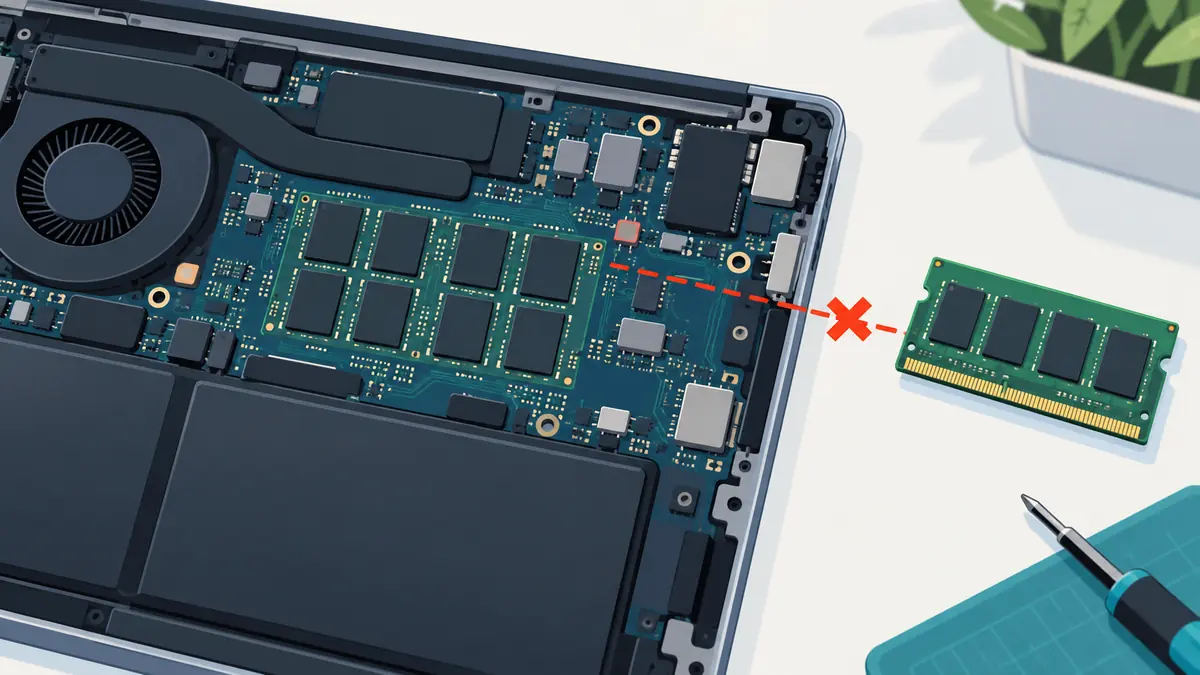
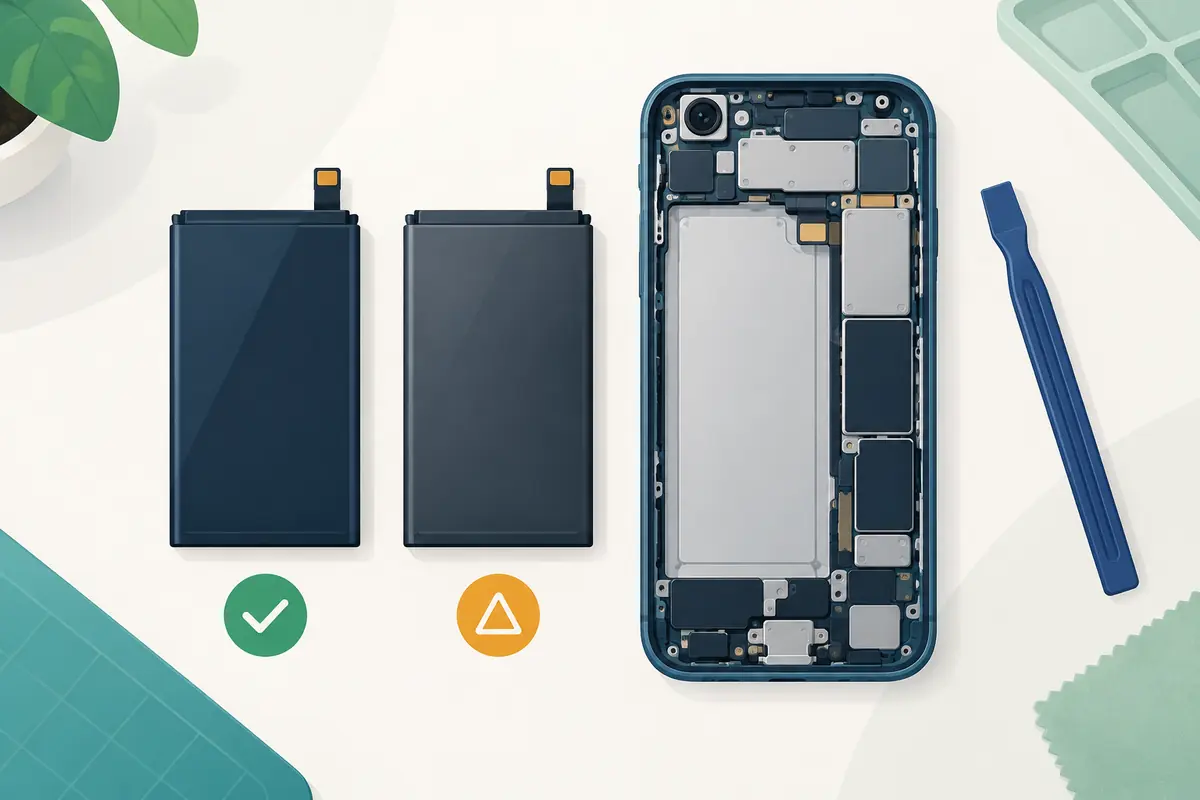
Modern displays can combine a high-resolution panel, touch layer, biometrics, frame, and bonded materials. The replacement assembly may cost a large share of the device’s market value even when disassembly is straightforward. Conversely, a common battery can be inexpensive while access requires careful adhesive removal.
Look at likely repairs separately: battery, display, charging port, back cover, keyboard, storage, fan, hinge, and camera. Obtain current prices for the exact configuration. A laptop’s 4K touch panel can cost much more than the non-touch panel offered in the same family.
Ask whether the quote uses a new manufacturer part, a service pack, a reclaimed original component, or a third-party part. The choice can change brightness, color, battery reporting, biometric behavior, warranty, and resale value.
Labor is local
A design that saves twenty minutes of technician time may lower labor cost where work is billed by time. A shop with fixed menu pricing may charge the same. In a region with few qualified technicians, travel and shipping can outweigh the theoretical disassembly advantage.
Authorized and independent providers also operate under different part, tooling, warranty, and calibration arrangements. One may be cheaper for a battery; the other may be the only route for a paired camera or supported configuration step.
Before buying, search repair providers near the place where the device will be used. Ask for out-of-warranty menu prices and typical turnaround. A global repair program is less helpful when every claim requires international shipment.
Availability is not immediacy
A methodology may reward a manufacturer for committing to supply spare parts for a period. That is valuable: a part cannot be fitted if it no longer exists. It does not guarantee that every color, capacity, region, or variant ships today.
Inventory can be delayed, backordered, restricted to professional repairers, or sold only as a larger assembly. A keyboard may be available only with the entire top case. A charging connector may come only with a daughterboard. The resulting bill can differ sharply from the price of the small failed item.
Check the parts catalog for the exact model. Look for required extras such as adhesive, screws, brackets, calibration tools, and return deposits. Save the result with the date because availability changes.
Documentation is useful, not sufficient
A clear service manual reduces uncertainty and helps a technician estimate work. It can show screw locations, adhesive procedures, safety steps, diagnostics, and configuration requirements. Google and Apple publish self-service material for eligible models and regions, for example.
A manual does not make every repair appropriate for a beginner. Lithium batteries can burn if punctured, and displays or biometric cables can be damaged during opening. Water-resistant adhesive, high voltage in some devices, and fragile connectors raise the stakes.
Read a manual before buying parts to understand the process, then decide whether professional labor is worth the risk. The presence of instructions should improve choice, not pressure an owner into self-repair.
Tools and software can change the real cost
A score may consider whether common or proprietary tools are required. The buyer should price those tools and any one-time fixtures. A $50 part is not a $50 repair if safe installation requires a heated fixture, press, torque driver, diagnostic access, or calibration process.
Software pairing and configuration matter after physical assembly. A genuine part may need a manufacturer procedure for battery health, display features, or camera calibration to work as intended. Ask whether the quote includes that step and what the phone will report afterward.
If a third-party workflow transfers electronics from the original part, understand what is being moved and why. The resulting system message can affect future service or resale even when basic function is restored.
Score the repair ecosystem around the device
Add a local “ecosystem check” beside the published score:
- Two nearby providers willing to service the exact model.
- Current prices for battery and display replacement.
- Parts source, expected delivery, and years of stated availability.
- Access to manuals, diagnostics, and post-repair configuration.
- Warranty length and remedy for parts and labor.
- Data-protection process and loaner or turnaround options.
This is not another universal index. It is a buyer-specific reality check. A strong global score plus a weak local ecosystem may produce an inconvenient ownership experience.
Use failure probability carefully
Buyers sometimes multiply every possible repair cost by a guessed probability and call the result expected maintenance. The method can be useful with good data, but personal guesses create false precision.
A simpler approach is to price one plausible battery service and one accidental screen repair, then run scenarios. If the phone remains attractive in both, repair cost is resilient. If a single screen break makes replacement unavoidable, insurance, a stronger case, or a different model may deserve attention.
Use your environment. A desk phone and a construction-site phone do not share the same damage risk. A laptop carried daily has a different hinge and impact exposure from one that stays docked.
A high score does not guarantee durability
Repairability asks how recoverable a device is after something fails. Durability asks how well it resists failure or wear. The concepts overlap but are not interchangeable.
A device can be easy to repair yet fragile. Another can be difficult to open but survive ordinary use well. Ingress protection, drop resistance, hinge testing, battery endurance, and software-support length add separate evidence.
The EU label for smartphones and tablets, for example, presents multiple kinds of information rather than treating repairability as the entire product story. Read the other fields relevant to your use.
A low score does not make repair impossible
Technicians develop methods, third-party suppliers enter the market, and common failures can become routine. A device with a mediocre overall score may have one easy, inexpensive repair that matters most to you.
The reverse is also true: a high score does not make board-level data recovery cheap or certain. Scores generally describe defined repair operations, not every catastrophic fault.
Ask about the specific failure history and repair menu. Model-level averages should guide the conversation, not end it.
Compare ownership cost, not repair price alone
A $180 battery replacement can be sensible on a supported phone that will serve three more years. A $90 battery can be poor value on an unsupported device with a cracked display and insufficient storage. Combine the quote with remaining useful life.
For each likely repair, record cost, downtime, warranty, and years expected after the work. Use our repair-or-replace cost checklist to compare the repaired device with a suitable replacement.
Do not use current resale price as the only ceiling. Data migration, accessories, support, and a replacement’s quality also affect the decision. But if a repair approaches the price of an equivalent warranted replacement, understand why before approving it.
How to read a repairability label before buying
- Identify the scoring system and version.
- Open the sub-scores or calculation sheet.
- Find which factors raised and lowered the result.
- Check the exact regional model and configuration.
- Price the two or three repairs most likely to matter.
- Confirm local provider, parts, tools, software, and turnaround.
- Compare the repair scenarios with supported years remaining.
This takes longer than choosing the greenest label. It also produces information the label was never designed to contain.
Questions for a repair quote
Ask whether the quote is fixed or estimated, which part is used, whether tax and adhesive are included, what happens if more damage is found, who pays shipping, whether data will be erased, what configuration follows installation, and how the work is warranted.
For a sealed device, ask what happens to water-resistance claims. For a battery, ask about capacity, system reporting, and recycling. For a display, ask about brightness, refresh rate, color, touch, biometrics, and any parts message.
A written answer is more useful than “same as original.” It creates a basis for comparing providers and resolving a problem later.
Keep the score in its time frame
A rating reflects a methodology and information available when the model was assessed. Parts prices, independent supply, software tools, and service coverage can improve or deteriorate later. Recheck the ecosystem when a repair is actually needed.
For a used device, confirm that the unit has not already been altered in a way the original score did not contemplate. Missing fasteners, frame damage, adhesive residue, and unknown replacement parts can make the next repair harder than the factory design suggests.
The practical answer
A repairability score measures design and support characteristics under a defined method. A repair quote prices one fault in a local market. The score can help identify a product likely to be serviceable; it cannot predict the part, labor, logistics, or warranty attached to your future repair.
Read the sub-scores, then make two calls: one to a parts catalog and one to a repair provider. The best ownership choice has both a repair-friendly design and a repair path the owner can actually afford and reach.
Convert a repairable design into a deliverable repair
The Fairphone Gen. 6 and Framework Laptop 13 make repair planning a useful part of shopping, but access to a design or guide is only one part of that plan. Check whether the needed component can be delivered to your address, which tools or service you need, and what happens while the device is out of use.
Obtain a delivered quote for a plausible first repair instead of assuming a favourable score means cheap maintenance. Keep parts, labour, shipping and service responsibility separate so you can compare offers fairly. If the parts route is uncertain in your region, treat that as an unresolved ownership cost. The advantage becomes concrete when the repair can actually be completed within your budget and available downtime.
| Keep in your decision record | What to write down |
|---|---|
| Likely repair | Choose a battery, display or other relevant component. |
| Delivered cost | Include parts, labour and delivery rather than the part alone. |
| Service route | Identify who performs and supports the repair. |
Apply the guide to a real shortlist:
Updated October 10, 2026: added a practical application and decision record. This documentation-based guide uses estimates where stated; individual condition, repair costs and regional support vary.