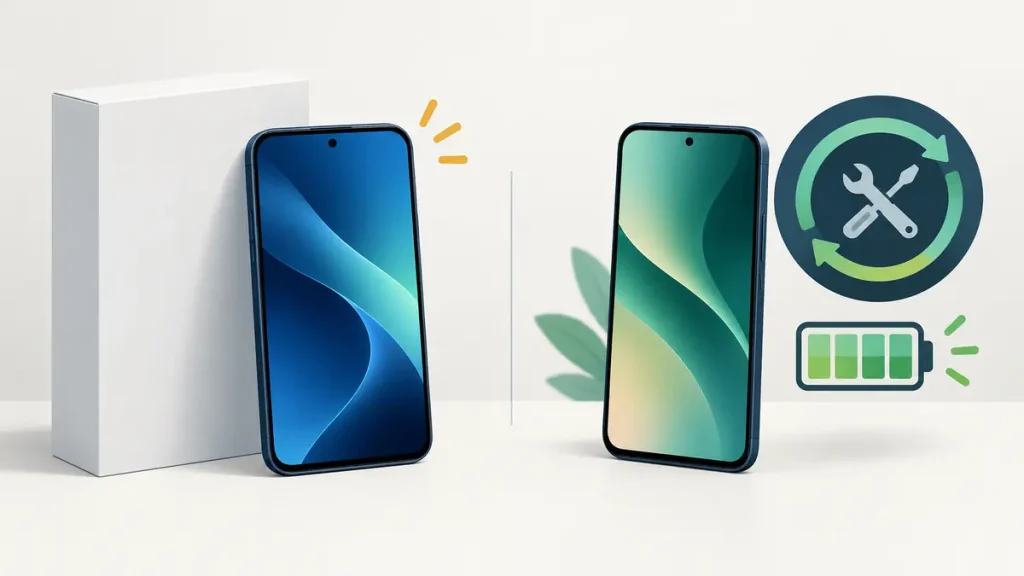
New vs Refurbished Phone: Warranty, Battery, and Update Support Compared
A refurbished phone can be a better purchase than a new one, but “refurbished” is not a technical grade. It can describe a manufacturer-inspected device with a new battery and full warranty, or a marketplace return that was wiped, polished, and placed in a generic box. The price tag does not reveal which process occurred.
A fair comparison looks at the phone you will actually receive: who performed the work, what was tested, the battery threshold, parts disclosure, warranty remedy, return window, lock status, and years of software support remaining. Once those items are written down, “new versus refurbished” becomes a much clearer ownership decision.
What a new phone normally buys
A genuinely new phone should be unused, sold in its intended market, and covered by the manufacturer’s standard new-product warranty. The battery begins near the start of its service life, seals have not been disturbed by repair, and the device should include the specified accessories or a clear notice that they are absent.
New does not always mean newly released. Old inventory can remain sealed while its software-support clock continues from launch. A discounted new phone from two generations ago may have fewer secure years left than a current refurbished model. Confirm both activation eligibility and remaining updates.
Retail channel matters. A gray-market import can be physically new but lack local bands, local warranty service, compatible eSIM features, or the expected regional software. Check the exact model number and warranty coverage in the country where the phone will be used.
What refurbishment can include
Refurbishment is a process, not a single condition. A strong program may inspect the enclosure and internal functions, test cameras and radios, replace parts that fall below a standard, install current software, clean the device, and back the result with a meaningful warranty. A weaker seller may perform little beyond a factory reset and visual sort.
Ask for the written process. Which components are tested? Is water or liquid damage excluded? Are replacement parts original, reclaimed, or third-party? Is the battery replaced or only required to exceed a percentage? Is biometric authentication tested? Does the phone retain any official water-resistance rating after repair?
A seller who cannot answer should be priced as an unknown-condition used-phone seller, regardless of the word “certified” in the listing.
Warranty: compare the remedy, not the badge
Record the warranty length, who provides it, where service occurs, and what the provider promises to do. A twelve-month seller warranty is not identical to a twelve-month manufacturer warranty if claims require international shipping or if the remedy is store credit rather than repair, replacement, or refund.
Read exclusions for batteries, displays, liquid exposure, cosmetic condition, accessories, and software. Check who pays return postage and whether an advance replacement is available. A warranty that costs half the phone’s value to use offers weak protection.
Also distinguish the return window from the defect warranty. The return period lets you reject a phone that is uncomfortable, misgraded, or incompatible even if it technically works. The warranty addresses faults that appear later. Test heavily while both protections overlap.
Battery condition can erase the discount
A battery is a consumable component. A refurbished phone may arrive with fewer cycles than another unit of the same age, but age, temperature history, and use all matter. The seller should state whether the battery is new, what minimum capacity is guaranteed, and how that capacity is measured.
“Tested battery” is incomplete. A test might only confirm that the phone charges and turns on. “At least 80 percent” is more specific, yet a phone beginning near that threshold may provide noticeably less runtime than new and may need service sooner. Add the expected battery-replacement cost to the purchase price before comparing.
Where the operating system reports battery health, inspect it during the return window. Also test charging, idle drain, heat, sudden percentage changes, and performance at a low charge. A health percentage is useful evidence, not a complete safety inspection. Swelling, screen lifting, odor, or unusual heat requires immediate attention and professional advice.
For background on normal aging, see how battery, hardware, and support shape a phone’s lifespan.
Software support is based on model age
Refurbishment does not restart the update clock. Replacing a screen and battery can restore hardware condition, but the manufacturer still treats the model as the generation it is. Calculate remaining security support from the maker’s policy and original timeline.
This is where an apparently expensive new model can become cheaper per supported year. A $300 refurbished phone with two secure years remaining costs $150 per supported year before repairs. A $520 new phone with six years remaining costs about $87 per supported year. The first option may still suit a two-year plan, but its discount is less dramatic than the sticker prices suggest.
Use the method in our guide to checking how many years of updates a phone has left. Do not borrow the policy of a newer model in the same family.
Parts can change the experience
A replacement display may have different brightness, color, touch response, refresh behavior, fingerprint compatibility, or power use. A replacement camera can affect focus or stabilization. Third-party batteries vary in capacity reporting and quality. Some phones display a parts or repair history; others provide little visible information.
Ask whether the phone has been opened and which parts were replaced. If the seller says “all original,” clarify whether that means the original parts from this device, used original parts from another device, or new service parts supplied through the manufacturer.
Water resistance deserves careful wording. Opening a sealed phone disturbs adhesive. A competent repair may replace the seal and test the device, but a refurbished seller should not imply that a used phone carries the same untouched factory condition unless the manufacturer explicitly warrants that claim. Treat water resistance as risk reduction, never permission to expose a phone deliberately.
Check locks, identity, and network compatibility
Before buying, confirm that the phone is not activation-locked to a previous owner and is not reported lost or stolen. Check the device identifier through the carrier or an authoritative service available in your country. Marketplace screenshots can be altered, so repeat checks when possible.
Confirm carrier lock status, supported bands, physical SIM and eSIM behavior, Wi-Fi calling, voice-over-LTE support, and any regional feature limits. A phone can accept a SIM yet perform poorly where a missing band carries most local coverage.
For an iPhone, the setup process should not request another person’s Apple Account. For Android, factory-reset protection should not demand the prior Google account. Do not pay a stranger who promises to remove an ownership lock after the sale.
Cosmetic grades need a translation
Labels such as Excellent, Very Good, Grade A, or Premium are chosen by sellers. They usually describe appearance, not battery capacity, repair history, internal corrosion, or remaining updates. Read the seller’s actual definition and photographs.
Inspect the display under bright and dim backgrounds for dead pixels, burn-in, discoloration, deep scratches, and touch dead zones. Examine camera glass, frame bends, buttons, speaker grilles, microphone openings, and the charging port. A case can hide damage; remove it during inspection if the seller permits.
Cosmetic wear can be a sensible way to save money when it is accurately priced and function is sound. A scratch is not the same as a structural bend or lifting screen.
A test plan for the return window
Do not spend the return window admiring the packaging. Set up the phone enough to test it, while keeping receipts and protective materials. Check:
- Calls, mobile data, Wi-Fi, Bluetooth, GPS, and hotspot use.
- Every camera, focus, flash, microphone, speaker, and vibration motor.
- Touch response across the screen, brightness, color, and biometric unlock.
- Wired and wireless charging where supported, cable fit, and temperature.
- Battery drain during a normal day and overnight idle.
- Storage capacity, model number, update status, and device identifiers.
- Buttons, proximity sensor, rotation, headphones or audio adapters, and USB data.
Install current official updates before judging app compatibility. If setup reveals an unknown management profile, enterprise enrollment, demo mode, or ownership lock, stop and contact the seller within the return period.
Calculate the complete ownership cost
Start with purchase price and tax. Add shipping, a charger if none is included, a case, screen protection, an immediate battery service, and any carrier activation charge. Subtract only a resale or trade-in value you can reasonably expect, not the maximum advertised offer.
Then divide by the shorter of two periods: how long you intend to keep the phone and how long official security support remains. This produces a simple cost per supported year. Include a risk allowance when the seller has a short return window, vague battery standard, or difficult warranty.
Environmental value matters too. Reusing a working phone can avoid demand for another device, while a manufacturer refurbishment can return parts and devices to productive use. That benefit is strongest when the phone remains supported and dependable rather than becoming electronic waste after a few months.
When new is the safer choice
Buy new when maximum battery life, untouched seals, the longest support runway, clear local warranty service, or predictable business deployment matters more than the discount. New is also sensible when refurbished prices are too close after adding a battery, charger, and weaker warranty.
A person who cannot tolerate downtime may value a manufacturer’s replacement network more than a marketplace saving. Someone buying for a remote family member may prefer the simplest support path even if an inspected refurbished unit looks attractive.
When refurbished is the better value
Refurbished can win when the program states its inspection and battery standards, includes an adequate return window and enforceable warranty, discloses parts and cosmetic condition, and sells a model with several supported years left. A lower price also leaves room for a future battery replacement without exceeding the new-phone budget.
The strongest comparison is often manufacturer-refurbished versus new from the same brand because documentation and service routes are easier to align. A reputable specialist can also be excellent; judge the written terms, not company size alone.
The practical answer
A new phone usually offers the cleanest warranty, freshest battery, and longest available support. A good refurbished phone can deliver similar daily use for less, but only when the seller turns “refurbished” into measurable promises.
Before paying, obtain the exact model, security-support endpoint, battery guarantee, repair and parts disclosure, network compatibility, return terms, and warranty remedy. Price the first likely repair. The better phone is not the one with the more reassuring adjective; it is the one whose remaining useful life and protections justify its total cost.
Sources
- Apple: About Apple Certified Refurbished products
- Samsung: Certified Re-Newed phones
- Google: Pixel software update policy
- Apple Support: About iPhone Parts and Service History
Last reviewed: September 6, 2026. Refurbishment standards, warranties, return rights, and update policies differ by seller, model, country, and date.
