80% Charge Limit vs Optimized Charging: Same Goal, Different Daily Tradeoffs
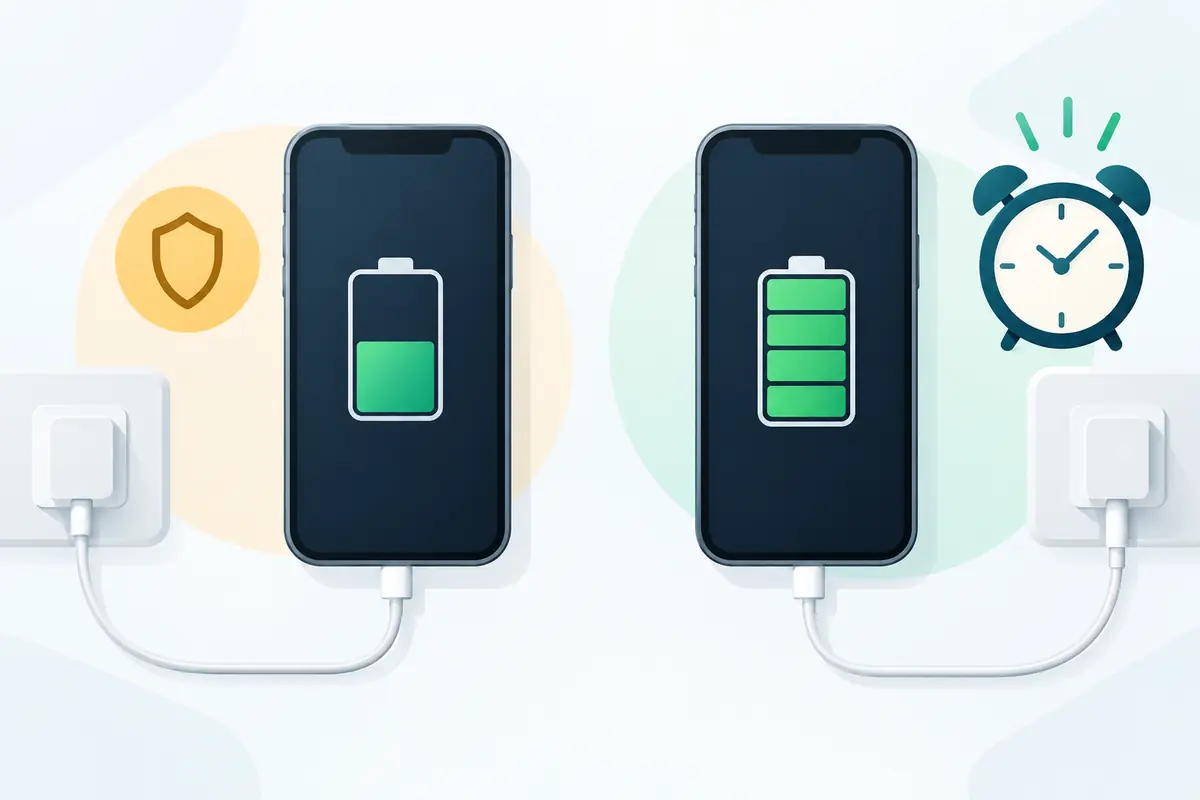
An 80-percent charge limit and optimized charging try to reduce the time a battery spends at a high state of charge. They do not create the same daily experience. One sets a visible ceiling; the other tries to deliver a full battery near the time the owner usually unplugs.
The better choice depends on how predictable the day is, how much reserve the device needs, where it spends time connected to power, and whether the owner wants certainty about the limit or certainty about runtime. Neither setting is a moral test of battery care.
What a fixed 80-percent limit does
A fixed limit tells the device to stop or pause charging near a selected level. The exact behavior varies. Some phones and laptops may occasionally charge beyond the limit for measurement or maintenance. Others let the owner choose from several thresholds rather than exactly 80 percent.
The main advantage is predictability: the battery usually avoids sitting completely full while the device remains plugged in. This suits a laptop used at a desk, a phone with generous runtime, a vehicle-mounted device, or anyone who finishes most days with substantial charge remaining.
The main cost is equally predictable. The owner begins with roughly one-fifth less indicated capacity than a full charge would provide. On a day with weak signal, navigation, video recording, hotspot use, or travel, that missing reserve can matter.
What optimized charging does
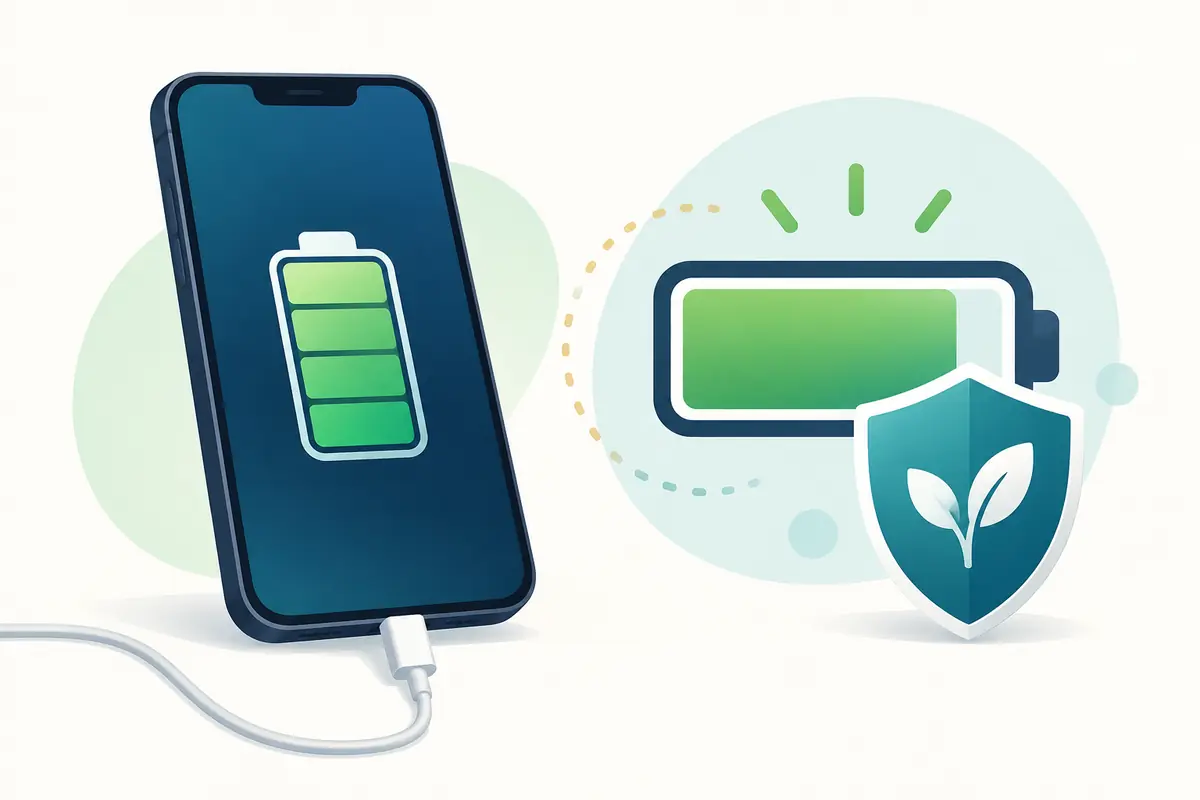
Optimized charging learns or infers when the device is likely to remain connected. It may pause near a lower level and complete charging closer to expected use. The owner can wake to 100 percent without the battery necessarily spending the entire night there.
This method protects convenience when a full-day range is useful. It is well suited to a regular overnight routine, provided the system recognizes that routine and conditions allow the feature to activate.
Its tradeoff is uncertainty. Travel, shift work, a new location, irregular alarms, or a changed schedule can make prediction less useful. The interface may offer a temporary “charge now” control, but behavior differs by platform.
Same goal, different control
Both features address exposure to high charge, but they control different variables:
- Fixed limit: controls the maximum level more directly.
- Optimized charging: controls when the final portion is delivered.
A limit reduces available energy every day unless overridden. Optimization tries to preserve full energy while reducing dwell time. The difference matters more than the shared marketing language.
Neither feature prevents all battery aging. Temperature, calendar time, cycling, discharge depth, charging power, signal conditions, and cell variation continue to influence the pack.
The desk-laptop case
A laptop connected to power for most of the week is the clearest candidate for a fixed limit. The owner rarely needs maximum unplugged runtime, so keeping the battery near a moderate range can fit with no daily sacrifice.
Before enabling it, learn where the control lives. It may be in firmware, a manufacturer utility, or the operating system. A setting tied to one utility may stop working after the utility is removed. Check the laptop maker’s documentation for the exact model.
Test an ordinary meeting or short trip at the limited level. If the laptop comfortably completes it, leave the limit on and learn how to override it before travel. Do not discover the control at an airport after the machine stops at 80 percent.
The unpredictable-phone case
A person whose days vary widely may value optimized charging more. A full morning battery provides margin for an emergency, a delayed train, weak coverage, or an unplanned call. If the phone usually charges overnight at one location, the feature has a routine to learn.
Check whether optimization is active rather than assuming. Some systems show a lock-screen or battery-settings message with an estimated completion time. If the feature does not trigger during travel, the phone may charge normally.
When a long day is known in advance, full charging is reasonable. Battery care should not reduce the phone’s availability for navigation, communication, tickets, or safety.
The large-battery phone case
A phone that normally ends the day above 40 percent can often use a fixed limit without changing habits. The owner still has reserve while spending less time near full charge. This is a good candidate for a two-week test.
Start by recording end-of-day charge for a normal week with the limit off. Enable it for the next comparable week. Note extra charging sessions, time below 20 percent, temperature, and any activity avoided because of battery anxiety.
If the limit creates repeated top-ups, the additional cycling and inconvenience may make optimized charging a better fit. The experiment should evaluate a routine, not chase a percentage.
The field-work case
Navigation, camera use, scanning, hotspot service, outdoor brightness, and poor cellular signal can consume power quickly. Workers may also have few safe charging opportunities. A full charge is a practical requirement, not a failure of discipline.
Optimized charging may still reduce overnight time at full. Carrying a compliant power bank can add resilience, but it brings weight and another battery to manage. A fixed 80-percent limit makes sense only if measured reserve remains adequate under a difficult day.
Employers should not shift operational risk to a worker by enforcing a low limit without providing charging access or spare devices.
Heat can outweigh the setting
A phone held at 80 percent while running navigation in direct sun can experience harsher conditions than a cool phone that reaches 100 percent shortly before use. A laptop with blocked vents may heat its battery regardless of the charge target.
Keep devices out of hot cars, off bedding, and away from direct sun while charging. Stop demanding workloads when temperature warnings appear. Use compatible chargers and undamaged cables. If wireless charging consistently creates more heat for a particular setup, compare it with wired charging under similar conditions.
Do not cool a hot device in a freezer or with condensation. Move it to a moderate, ventilated place and allow it to recover.
Does a limit waste 20 percent of the battery?
The capacity remains present; the setting chooses not to use the top portion during routine charging. Owners can often disable or override the limit when they need more range. Think of it as reserving capacity, not physically removing it.
There is still a daily opportunity cost. If limiting charge causes the phone to reach a very low level every evening, a higher target or optimized charging may provide a better balance. Avoid trading one extreme for the other.
Why the phone may charge beyond the limit
Manufacturers sometimes allow an occasional full charge to maintain accurate state-of-charge estimates or for other system needs. A limit may also be temporarily disabled by the owner, an update, a reset, a device mode, or an adaptive policy.
Read the interface language. “About 80 percent,” “maximum 80 percent,” and “optimized to 80 percent” can describe different behavior. If the device repeatedly ignores the documented setting, install official updates and consult support rather than assuming the battery is defective.
Can both features run together?
Some systems present a choice between a hard limit and adaptive charging. Others apply adaptive behavior inside a broader limit or offer several protection modes. The menu and priorities can change with software updates.
Choose based on the exact description shown on the device. Do not copy instructions for another brand or generation. Take a screenshot of the setting and review it after a major update or factory reset.
Overnight charging is a routine question
Modern devices manage charging and should not simply force energy into a full battery without control. Overnight risk is more closely tied to heat, damaged equipment, poor ventilation, and product condition than to the clock alone.
Do not charge under a pillow or on a soft surface that blocks cooling. Replace frayed cables and loose adapters. Use equipment that meets the manufacturer’s specifications and relevant safety requirements.
Optimized charging is designed for the routine many owners already use. A fixed limit can also work overnight, especially for a device that remains connected well into the day.
Fast charging does not decide the winner
Charging systems vary power throughout a session. A device may accept higher power at a lower state of charge and slow as it fills or warms. A high-wattage adapter does not necessarily force that wattage into every phone; compatible systems negotiate.
Use fast charging when time matters. For routine desk or overnight use, a slower compatible charger may generate less heat in some setups, but measure the actual device rather than relying on the label. A poor-quality slow charger is not safer merely because it is slow.
A decision table in words
Choose a fixed limit when daily energy needs are modest, the device spends long periods plugged in, the schedule varies but access to power is easy, and the owner wants a clear ceiling.
Choose optimized charging when full range is regularly useful, charging happens on a predictable schedule, and reducing time at full is more important than avoiding a full charge entirely.
Use ordinary full charging when a demanding day, emergency preparation, travel, or unreliable power makes reserve the priority. Re-enable the preferred protection afterward if needed.
Run a fourteen-day comparison
For seven days, use optimized charging. Record unplug time, starting percentage, end-of-day percentage, extra charges, lowest level, unusual heat, and whether optimization activated. For the next seven comparable days, use the fixed limit and record the same items.
Ignore minor day-to-day variation. Look for a pattern: repeated inconvenience, more time at very low charge, or no meaningful change. The best setting is the one that protects the battery without making the device unreliable for its job.
For a broader explanation of high state of charge, see what charging to 100 percent and charge limits actually do.
Reconsider the setting as the battery ages
A limit that felt effortless on a new battery may become restrictive after usable capacity declines. Re-run the weekly test when end-of-day reserve changes noticeably. The right response may be a higher limit, optimized charging, a battery inspection, or replacement service.
Do not wait for a setting to compensate for swelling, repeated shutdowns, or abnormal heat. Charging controls manage routine behavior; they are not repairs. If service is needed, ask how a replacement battery will interact with the phone’s health reporting and charging features.
The practical answer
An 80-percent limit gives direct, predictable control and works best when the missing reserve is rarely needed. Optimized charging preserves the option of a full battery and works best when the device can learn a stable charging routine.
Use evidence from your own week. Keep temperature and equipment condition in view, override the setting for demanding days without guilt, and revisit the choice when work, travel, battery condition, or software changes.
Choose the charging setting around a real week
For phones such as the Pixel 9a or iPhone 16, check the charging controls available on the exact software version before following a generic recommendation. A setting that works on a desk-heavy week may be inconvenient during travel. Battery care should support the way the phone is used, rather than require you to tolerate repeated interruptions.
Record days on which the available charge is insufficient, and note whether charging opportunities or unusually heavy tasks explain the shortfall. Change the setting deliberately when your routine changes, then reassess. This does not measure a long-term battery-life benefit, but it does establish whether the daily compromise is workable. Do not present a short personal comparison as proof that one setting adds a specific number of years.
| Keep in your decision record | What to write down |
|---|---|
| Routine | Separate ordinary workdays from travel or unusually heavy use. |
| Observed shortfall | Record when available charge interferes with the day. |
| Revisit trigger | Reconsider after a routine or battery-condition change. |
Apply the guide to a real shortlist:
Updated October 10, 2026: added a practical application and decision record. This documentation-based guide uses estimates where stated; individual condition, repair costs and regional support vary.